
Level Transmitters & Indicators in Lahore, Pakistan
Radar, ultrasonic, submersible, magnetic and flush-diaphragm level instruments for tanks, silos, sumps and boilers.
Reliable level measurement for tanks, silos and sumps
A level transmitter measures how full a tank, silo, sump or vessel is and sends that reading as an electrical signal to a controller, PLC or display. Good level measurement protects pumps from running dry, prevents overflows, and keeps inventory and process control accurate.
The right technology depends on the liquid or solid, the vessel, the temperature, and whether the surface is calm, foamy or full of vapour. A One Instruments supplies level instruments for most industrial applications and can help you choose between contact and non-contact options.
What We Supply
Level instruments we supply
Radar level transmitters
Non-contact measurement using microwaves. Radar readings are not affected by changes in temperature, pressure or vapour in the tank, so radar suits demanding applications such as chemical and process vessels.
Ultrasonic level transmitters
Non-contact measurement using sound waves. A cost-effective choice for water, wastewater and open tanks and sumps where the surface is reasonably calm and there is little vapour or foam.
Submersible level transmitters
A pressure sensor lowered into the liquid measures the hydrostatic pressure of the liquid above it and converts it to level. Widely used in wells, boreholes, water tanks, sumps and reservoirs.
Flush-mount diaphragm transmitters
Mounted on the side or bottom of a tank with a flush diaphragm, which avoids dead pockets where thick or sticky media could build up. Suited to viscous liquids and slurries.
Magnetic level indicators & transmitters
A float in a chamber moves with the liquid and magnetically flips a visible indicator on the outside, giving a clear local reading. A transmitter can be added for remote signalling. A dependable option for hot, pressurised or hazardous liquids.
Level indicators & displays
Panel and field indicators that show the level reading from a transmitter signal, so operators can monitor tanks at a glance.
How to choose a level transmitter
- Contact or non-contact: Radar and ultrasonic sensors never touch the product; submersible and diaphragm types do.
- Liquid properties: Viscous, sticky, corrosive or foamy media can rule out some technologies.
- Temperature and pressure: Boilers and pressurised vessels need instruments rated for the conditions.
- Vessel shape and obstructions: Agitators, ladders and narrow nozzles can interfere with non-contact readings.
- Range and accuracy: Know the full height of the vessel and how precise the reading must be.
- Output signal: 4-20 mA is the most common output; tell us what your PLC or indicator accepts.
Industries
Industries We Supply
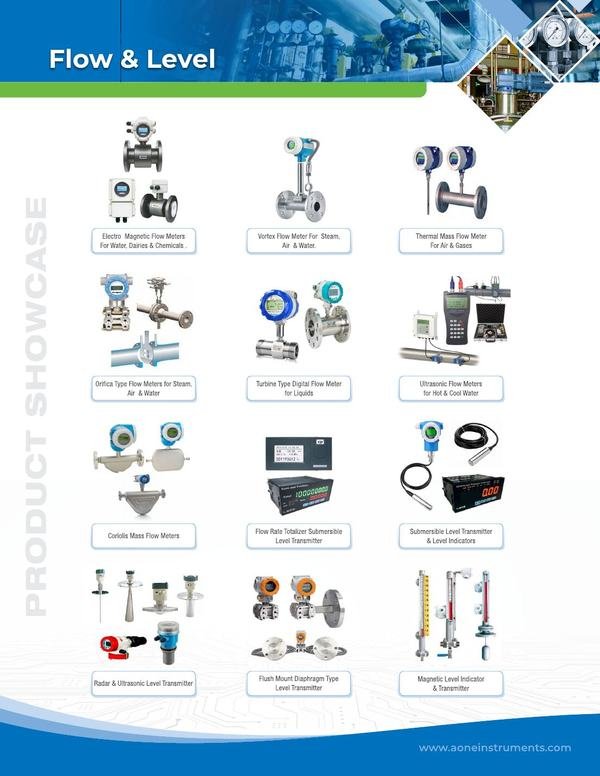
From Our Catalogue
See the Flow & Level range
Our product catalogue shows photographs of each instrument type in this range. Browse every page online, or download the full catalogue as a PDF to keep for reference.
Why A One Instruments
Buy from a supplier you can rely on
Quality Assured
Genuine equipment from trusted global manufacturers, tested and calibrated.
20+ Years Experience
Hands-on experience across sugar, textile, paper, cement, food and more.
Calibration & Support
Calibration, maintenance and technical support to keep your instruments accurate.
Dispatch Across Pakistan
Nationwide dispatch and dependable after-sales support from our Lahore office.
FAQ
Level Transmitters: Frequently Asked Questions
What is the difference between radar and ultrasonic level transmitters?
Both are non-contact. Ultrasonic transmitters use sound waves and work well for water, wastewater and open tanks with a calm surface. Radar uses microwaves and is less affected by temperature, pressure, vapour and condensation, so it is preferred for harder applications. Radar generally costs more.
What is a submersible level transmitter used for?
A submersible (hydrostatic) level transmitter sits at the bottom of a tank, well or sump and measures the pressure of the liquid above it, which it converts to a level reading. It is a simple, economical solution for water tanks, boreholes, sumps and reservoirs.
What is a magnetic level indicator?
A magnetic level indicator has a float in a chamber attached to the vessel. The float's magnet flips coloured flags on the outside, so operators can read the level visually even without power. A transmitter can be added to send the level to a control system.
Which level transmitter is best for sticky or viscous liquids?
Flush-mount diaphragm transmitters and non-contact radar are usually good choices, because there is no pocket or probe for the product to build up in.
What output do level transmitters give?
The most common output is a 4-20 mA signal, which connects easily to PLCs, indicators and recorders. Other outputs may be available depending on the model, so tell us what your control system accepts.
Related Products
You may also need
Flow Meters
Electromagnetic, vortex, ultrasonic, turbine, Coriolis and thermal mass flow meters.
View rangePressure Gauges & Transmitters
Pressure and vacuum gauges, diaphragm gauges, switches and D/P transmitters.
View rangeSensors & Power Supplies
Proximity and photo sensors, encoders, load cells, gas detectors, pH meters and power supplies.
View range
Looking for level transmitters?
Send us your requirement and our team will recommend the right product and send you a quotation.
Request a Quote